Research Use Only: All content and products are for scientific research — not for human or animal use. Full disclaimer
Research PeptidesMelanocortin AgonistSourcing Guide
Melanotan 1 (MT-1) Peptide: Research Profile & Sourcing Guide
A comprehensive reference on Melanotan 1 (afamelanotide) — covering molecular structure, MC1R mechanism, published in vitro and animal model findings, comparison with MT-2, and a practical guide to sourcing research-grade Melanotan 1 peptide.
June 2026
·
12 min read
·
BioLongevity Labs Research Team
·RUO — Research Use Only
Compound
Melanotan 1 (MT-1)
Also Known As
Afamelanotide · α-MSH analog
CAS Number
75921-69-6
Molecular Formula
C₇₈H₁₁₁N₂₁O₁₉
Molecular Weight
1646.85 Da
Structure
Linear 13-AA peptide
Primary Receptor
MC1R (full agonist)
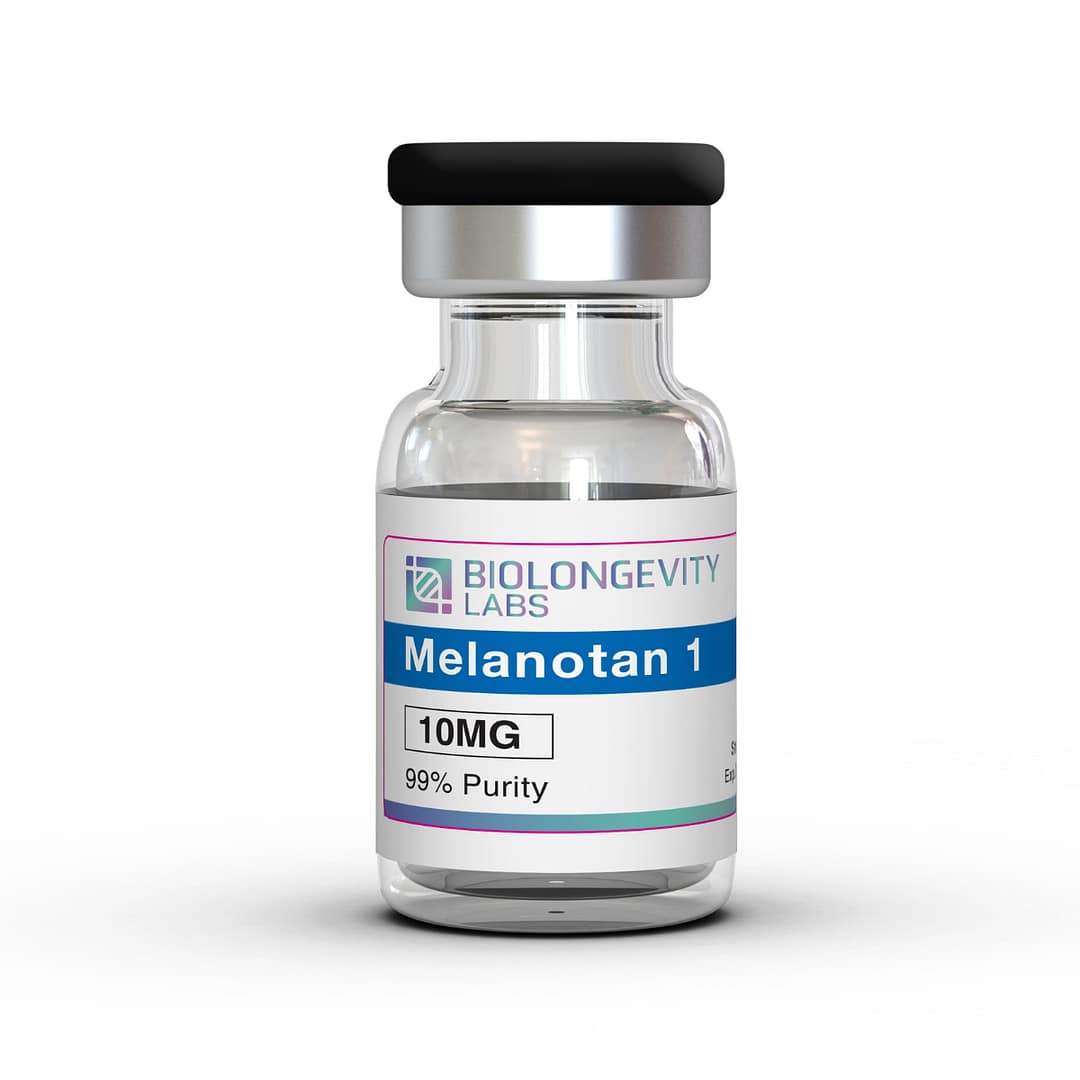
Research Vial
10mg · Lyophilized
§ 01
What Is Melanotan 1?
Melanotan 1 (MT-1), also known as afamelanotide, is a synthetic linear analog of alpha-melanocyte-stimulating hormone (α-MSH). It is a 13-amino acid peptide designed to mimic and extend the biological activity of endogenous α-MSH at melanocortin receptors — particularly the melanocortin 1 receptor (MC1R), which is primarily expressed on melanocytes in the skin.
Melanotan 1 was originally developed in the 1980s at the University of Arizona by researchers studying melanocortin biology and its downstream effects on pigmentation. The compound was engineered to be a more potent and longer-lasting analog than naturally occurring α-MSH, which has a very short half-life in circulation due to rapid enzymatic degradation.
In research contexts, Melanotan 1 peptide is studied as a pharmacological tool for investigating MC1R biology, eumelanin synthesis pathways, photoprotection mechanisms in cell models, and systemic inflammatory signaling — all within in vitro and controlled research settings.
Research Use Only
All references to Melanotan 1 (MT-1) in this article are in the context of in vitro and laboratory research. BioLongevity Labs supplies Melanotan 1 for Research Use Only (RUO) — it is not approved for human administration, is not a drug or medication, and is not intended for self-experimentation. See full disclaimer.
13
Amino Acids
1647
Dalton MW
MC1R
Primary Target
§ 02
Molecular Structure & Properties
The structure of Melanotan 1 is defined by its 13-amino acid sequence, which mirrors that of naturally occurring α-MSH with key substitutions that enhance receptor affinity and metabolic stability. The natural α-MSH sequence is Ac-Ser-Tyr-Ser-Met-Glu-His-Phe-Arg-Trp-Gly-Lys-Pro-Val-NH₂ (13 residues).
MT-1 (afamelanotide) is a Nle⁴, D-Phe⁷ analog of α-MSH, meaning it incorporates two key amino acid substitutions relative to the natural sequence:
Position 4 — Norleucine (Nle) substitution: Methionine at position 4 is replaced with norleucine, a non-natural amino acid. This modification eliminates oxidation of the methionine sulfur, significantly improving the compound’s chemical stability during synthesis, storage, and in aqueous solution.
Position 7 — D-Phenylalanine (D-Phe) substitution: The L-phenylalanine at position 7 is replaced with its D-stereoisomer. This substitution is critical for increased receptor potency and dramatically extended biological half-life, as D-amino acid residues resist enzymatic degradation by endopeptidases that rapidly cleave natural α-MSH.
The combination of these two substitutions produces a compound with substantially greater MC1R potency and a markedly extended plasma half-life compared to native α-MSH, which is degraded within minutes by serum proteases. MT-1’s modified structure resists this rapid proteolytic clearance, making it a more tractable research tool for studying melanocortin receptor pharmacology in cell and tissue models.
Melanotan 1 acts as a full agonist at the melanocortin 1 receptor (MC1R), a G protein-coupled receptor (GPCR) expressed predominantly on melanocytes, keratinocytes, Langerhans cells, and various immune cell populations. Activation of MC1R by MT-1 initiates a well-characterized intracellular signaling cascade with multiple downstream consequences of research interest.
MC1R Binding & cAMP Signaling
Upon binding MC1R, MT-1 activates the associated Gαs protein, stimulating adenylyl cyclase activity and increasing intracellular cyclic adenosine monophosphate (cAMP) concentrations. Elevated cAMP activates protein kinase A (PKA), which phosphorylates the transcription factor CREB (cAMP response element-binding protein). Phosphorylated CREB then upregulates expression of MITF (microphthalmia-associated transcription factor), the master regulator of melanocyte identity and function.
Eumelanin Synthesis Pathway
MITF activation drives transcription of melanogenic enzymes — most critically tyrosinase, TRP-1 (tyrosinase-related protein 1), and TRP-2 — which catalyze the conversion of tyrosine through DOPA and dopaquinone to eumelanin. Research in melanocyte cell models demonstrates that MT-1 stimulation selectively promotes the eumelanin (brown/black pigment) pathway over the pheomelanin (red/yellow pigment) pathway, a distinction of particular interest in photoprotection and photobiology research.
“MC1R activation by α-MSH analogs shifts the melanocyte phenotype decisively toward eumelanin synthesis — a biologically protective pigmentation pathway that absorbs a broader UV spectrum than pheomelanin.”
Melanocortin receptor biology context — in vitro research
Anti-Inflammatory Signaling
Beyond melanogenesis, melanocortin receptors have been documented in diverse immune and inflammatory cell populations. Research in macrophage and dendritic cell models has investigated MC1R-mediated anti-inflammatory effects, including modulation of NF-κB signaling and cytokine production (IL-1β, TNF-α). These studies position MT-1 and related melanocortin analogs as research tools for inflammatory pathway investigation — independent of their melanogenic activity.
MC1R Selectivity Profile
A key feature distinguishing MT-1 from MT-2 in research contexts is its receptor selectivity. MT-1 (afamelanotide) demonstrates high selectivity for MC1R over other melanocortin receptor subtypes (MC3R, MC4R, MC5R). This selectivity makes it a useful pharmacological probe for dissecting MC1R-specific signaling pathways without the confounding activity at MC4R — which mediates appetite, energy balance, and sexual function through separate pathways — that characterizes MT-2.
§ 04
Melanotan 1 vs Melanotan 2: Key Differences
A frequent question in research sourcing is the distinction between Melanotan 1 (MT-1) and Melanotan 2 (MT-2). While both are synthetic melanocortin analogs descended from α-MSH research, they differ substantially in structure, receptor selectivity, and research application.
Melanotan 1 (MT-1)
Afamelanotide · [Nle⁴,D-Phe⁷]-α-MSH
StructureLinear, 13 AA
Primary receptorMC1R (high selectivity)
MC4R activityMinimal
MW1646.85 Da
Research focusMelanogenesis, MC1R pharmacology
Vial size10mg
Melanotan 2 (MT-2)
Cyclic · [Nle⁴,D-Phe⁷,Cys⁴·¹⁰]-α-MSH fragment
StructureCyclic, 7 AA
Primary receptorMC1R, MC3R, MC4R, MC5R
MC4R activitySignificant
MW~1024 Da
Research focusBroad melanocortin signaling, MC4R pathways
Vial size10mg
Research Selection Guidance
For research specifically targeting MC1R biology, eumelanin pathways, or photoprotection mechanisms, MT-1 (afamelanotide) is the more receptor-selective tool. For research requiring engagement of MC4R pathways alongside MC1R, MT-2’s broader receptor profile may be more appropriate. Both are available as 10mg lyophilized research vials from BioLongevity Labs.
§ 05
Published Research Findings
Melanotan 1 (afamelanotide) has been the subject of substantial published research, primarily in the contexts of melanocyte biology, UV photoprotection models, and melanocortin receptor pharmacology. The following summarizes key research areas — all in the context of in vitro cell studies, animal models, or clinical research conducted in regulated settings.
Research Context Disclaimer
The following summarizes findings from published peer-reviewed research. This information is provided for scientific education. No claims about efficacy or safety in humans are made. BioLongevity Labs supplies MT-1 for in vitro research only. References are provided for academic context.
MC1R Agonism & Melanogenesis — In Vitro Models
Cell-based studies in human melanocyte cultures have consistently demonstrated that afamelanotide (MT-1) stimulates MC1R-mediated cAMP production at low nanomolar concentrations, with EC50 values substantially lower than native α-MSH. This potency enhancement is attributable to the D-Phe⁷ substitution, which confers greater receptor affinity. Downstream, MITF upregulation and tyrosinase activity increases in MT-1-treated melanocyte cultures have been documented across multiple laboratories, with eumelanin content measurements confirming pigmentation pathway activation.
Photoprotection Research in Animal Models
Animal model research has examined afamelanotide’s capacity to upregulate constitutive eumelanin levels prior to UV exposure, modeling a “pre-tanning” photoprotection hypothesis. Studies in murine models demonstrated reduced UV-induced DNA damage markers (cyclobutane pyrimidine dimers) in skin with elevated eumelanin content. These findings positioned afamelanotide as a research tool for studying eumelanin’s role in DNA photodamage prevention — distinct from sunscreen-based photoprotection mechanisms.
Erythropoietic Protoporphyria (EPP) Research
Afamelanotide (branded as Scenesse®) received regulatory approval in the EU (2014) and subsequently in Australia and the USA for the prevention of phototoxicity in adults with erythropoietic protoporphyria (EPP) — a rare genetic disorder causing extreme photosensitivity. This regulatory pathway was based on controlled clinical trials demonstrating extended pain-free sun exposure in EPP patients. This application is the only FDA/EMA-approved clinical use of afamelanotide and is distinct from any research use of MT-1 peptide vials. Research-grade MT-1 purchased from BioLongevity Labs is not equivalent to pharmaceutical-grade Scenesse® and is not for human use.
Anti-Inflammatory Pathway Research
Independent of melanogenesis, published studies in macrophage and monocyte cell models have investigated α-MSH and afamelanotide’s anti-inflammatory properties. MC1R activation in these models has been associated with reduced secretion of pro-inflammatory cytokines including IL-1β, IL-6, and TNF-α, via NF-κB pathway modulation. This line of research positions melanocortin agonists as tools for studying innate immune regulation — an active area of melanocortin receptor biology beyond skin pigmentation.
Research Summary
Melanotan 1 — Primary In Vitro & Preclinical Research Areas
MT-1 research spans: (1) MC1R pharmacology and structure-activity relationship studies; (2) eumelanin synthesis pathway investigation in melanocyte cell models; (3) UV-induced DNA damage models in skin cells; (4) melanocortin receptor anti-inflammatory signaling in immune cell models; (5) comparative melanocortin receptor selectivity profiling versus other α-MSH analogs. Researchers should consult primary literature for specific protocols, cell line considerations, and concentration ranges appropriate to their experimental models.
§ 06
Melanotan 1 Sourcing Guide
Researchers seeking to buy Melanotan 1 for in vitro work or laboratory research should be aware that not all sources of MT-1 peptide meet the analytical standards required for reliable, reproducible data. The research peptide market includes a broad range of suppliers with highly variable quality practices — making vendor evaluation a critical step before placing an order.
What to Look For When Sourcing Melanotan 1
Quality Criterion
Why It Matters
Standard
HPLC Purity
Confirms the target peptide is the dominant species — impurities introduce experimental confounds
≥99%
LC-MS Confirmation
Independently verifies molecular weight matches MT-1 (1646.85 Da), ruling out truncated sequences or analogs
Required
Endotoxin Testing
LPS contamination causes artifactual cytokine responses in immune cell assays — critical for inflammatory research
LAL Tested
Certificate of Analysis
Documents all test results for the specific batch — verifiable and traceable to a certified lab
Batch-specific
3rd Party Testing
In-house testing is inherently conflicted; independent labs provide unbiased analytical data
Independent lab
Lyophilized Format
Lyophilized powder is stable for 24+ months; liquid formulations degrade faster and may contain additives
Preferred
RUO Compliance
Supplier must clearly state Research Use Only classification and require account registration and RUO acknowledgment
Required
Sterility Testing
Confirms absence of microbial contamination — particularly relevant for cell culture applications
Recommended
Sourcing — BioLongevity Labs
Research-Grade Melanotan 1 for Sale
BioLongevity Labs supplies Melanotan 1 (MT-1) as a 10mg lyophilized research vial at ≥99% purity, independently verified by a certified third-party laboratory before every batch release. Account registration and RUO acknowledgment are required.
99%+ Purity — HPLC with UV detection, full chromatogram in COA
LC-MS Verified — molecular weight confirmed at 1646.85 Da
Endotoxin Screened — LAL method, result documented in COA
COA Available Before Purchase — download and verify before ordering
Zero Fillers or Additives — pure active compound, no excipients
Researchers searching online for “melanotan 1 for sale” will encounter vendors with highly variable quality standards. Many list peptides without COAs, use in-house-only testing, or do not clearly state RUO classification. Always request a batch-specific COA from a named independent laboratory before purchasing any research peptide. The accession number, test dates, and lab name should be verifiable.
§ 07
Understanding MT-1 Quality Standards
Analytical quality of research-grade Melanotan 1 peptide is directly relevant to the reliability of experimental results. A peptide preparation at 90% purity contains 10% other species — which may include truncation sequences, deletion analogs, oxidized variants, or aggregates — each of which could produce confounding signals in sensitive biological assays.
HPLC Analysis of Melanotan 1
High-Performance Liquid Chromatography with UV detection (typically at 220nm for peptide bonds and 280nm for aromatic residues) is the primary method for determining MT-1 purity. A well-resolved chromatogram for a high-purity MT-1 preparation shows a single dominant peak corresponding to the intact 13-amino acid sequence, with all minor peaks summing to less than 1% of total area. Researchers should examine the actual chromatogram image in the COA — not just the stated percentage — to verify peak shape and resolution.
LC-MS Identity Confirmation
Liquid Chromatography–Mass Spectrometry (LC-MS) confirms that the material in the vial is actually Melanotan 1 (afamelanotide) and not a related analog or substituted compound. The expected [M+H]⁺ ion for MT-1 is approximately m/z 824.0 (doubly charged) or m/z 549.7 (triply charged), from a parent mass of ~1646.85 Da. A COA that does not include LC-MS data should be considered incomplete for research purposes.
Endotoxin Considerations for MT-1 Research
For researchers using MT-1 in immune cell models — macrophages, dendritic cells, or peripheral blood mononuclear cells — endotoxin testing is not optional. Lipopolysaccharide (LPS) contamination from bacterial cell walls during peptide synthesis is a well-documented source of artifact in inflammatory cytokine assays. Endotoxin concentrations as low as 0.1 EU/mL can trigger TLR4-mediated responses that overwhelm or mask peptide-specific signaling. Confirm that the COA includes an endotoxin result (EU/mg) from the LAL assay.
§ 08
Reconstitution Notes for MT-1
Melanotan 1 is supplied as a lyophilized powder. Reconstitution should follow standard peptide protocols with attention to MT-1-specific solubility characteristics.
Recommended solvent: 0.1% acetic acid in sterile water, or bacteriostatic water (BAC water). MT-1 dissolves readily in mildly acidic aqueous solutions. Avoid strongly alkaline conditions which may cause racemization at the D-Phe⁷ position.
Reconstitution technique: Inject solvent gently against the inner vial wall; allow to wet the lyophilized cake, then gently swirl. Do not vortex — mechanical shear can promote peptide aggregation.
Working concentration: For cell-based assays, stock solutions of 1–5 mg/mL are typical, with experimental concentrations in the nanomolar range (1–100 nM) for receptor-level studies. Consult primary literature for your specific assay system.
Aliquoting: Pre-aliquot reconstituted stock into single-use volumes before freezing. Each freeze-thaw cycle degrades peptide integrity — limit to fewer than 3 cycles per aliquot.
Storage after reconstitution: Reconstituted MT-1 in BAC water is stable at 4°C for up to 2 weeks. For longer storage, aliquots should be kept at −80°C. Protect from light at all stages — aromatic residues (Tyr, Trp, Phe) are photosensitive.
Reconstitution Calculator
Use BioLongevity Labs’ Peptide Reconstitution Calculator to determine the exact solvent volume required for any target concentration from a 10mg MT-1 vial. Available free in the research resources section — no account required.
§ 09
Frequently Asked Questions
Melanotan 1 (MT-1), also known as afamelanotide, is a synthetic analog of alpha-melanocyte-stimulating hormone (α-MSH). It is a 13-amino acid linear peptide that acts as a full agonist at the melanocortin 1 receptor (MC1R), stimulating the eumelanin synthesis pathway in melanocyte cell models. It is available as a research-grade peptide for in vitro and laboratory research only — not for human administration.
MT-1 (afamelanotide) is a linear 13-amino acid peptide with high selectivity for MC1R. MT-2 is a shorter cyclic 7-amino acid peptide with broader melanocortin receptor activity including MC3R and MC4R. For research targeting specifically MC1R biology and eumelanin pathways, MT-1 is the more selective tool. MT-2’s broader receptor profile — including significant MC4R activity — introduces additional signaling variables compared to MT-1.
Research-grade Melanotan 1 (MT-1) is available from BioLongevity Labs as a 10mg lyophilized research vial at ≥99% purity, independently verified by HPLC and LC-MS with a batch-specific Certificate of Analysis available before purchase. Account registration and Research Use Only acknowledgment are required. View the MT-1 product page →
Research-grade Melanotan 1 should be independently verified at ≥99% purity by HPLC with UV detection, with molecular identity confirmed by LC-MS showing the expected mass of ~1646.85 Da. A batch-specific Certificate of Analysis from a certified, named third-party laboratory (not in-house) should be available and downloadable before purchase. Endotoxin testing results should also be included, particularly for researchers using MT-1 in immune cell assays.
Scenesse® is the pharmaceutical-grade brand name product of afamelanotide, approved by the EMA and FDA for the prevention of phototoxicity in adults with erythropoietic protoporphyria (EPP). Research-grade Melanotan 1 peptide from BioLongevity Labs is not Scenesse®, is not manufactured to pharmaceutical standards, and is not approved for any medical use. They share the same active sequence (afamelanotide) but are entirely different product categories. BioLongevity Labs MT-1 is Research Use Only — not for human administration.
Lyophilized (unopened) vials: Store at −20°C, protected from light and moisture. Stable for 24+ months under these conditions. Reconstituted solutions: Store at 4°C in BAC water for up to 2 weeks; or aliquot and store at −80°C for extended stability. Limit freeze-thaw cycles to fewer than 3 per aliquot. Melanotan 1 contains aromatic residues (Tyr, Trp) and should be protected from UV exposure at all stages.
The correct CAS number for Melanotan 1 (afamelanotide, [Nle⁴,D-Phe⁷]-α-MSH) is 75921-69-6. This should be clearly stated in the Certificate of Analysis provided with any research vial. Verify this against publicly available chemical registry databases (PubChem, ChemSpider) to confirm you are purchasing the correct compound. Discrepancies in CAS numbers between the product listing and the COA are a red flag.
Chemical Supplier Statement: BioLongevity Labs is a chemical supplier — not a compounding pharmacy (503A) or outsourcing facility (503B) under the FD&C Act. All products are Research Use Only (RUO).
Not for Human Use: Melanotan 1 (MT-1) supplied by BioLongevity Labs is intended solely for in vitro research, pharmaceutical research, or development of new tests. It is not a drug, medication, or dietary supplement. It is not approved for human administration. Misusing these products may be illegal. Customers are responsible for complying with all applicable laws in their jurisdiction.
Research Content: All scientific information in this article is provided for educational purposes. No claims regarding efficacy, safety, or therapeutic application in humans are made. References to published research are provided for academic context only and do not constitute endorsement of any off-label use.
A comprehensive reference on Melanotan 1 (afamelanotide) — covering molecular structure, MC1R mechanism, published in vitro and animal model findings, comparison with MT-2, and a practical guide to sourcing research-grade Melanotan 1 peptide.
Vilon is a synthetic dipeptide bioregulator (Lys-Glu) — one of the shortest and most studied members of the short-chain peptide bioregulator family. This guide covers its molecular identity, CAS number, research classification, research background, reconstitution protocol, storage requirements, and how to source verified Vilon for in vitro scientific research. All information is for Research Use Only.
A comprehensive research guide to Body Protection Compound-157 — covering molecular structure, mechanism of action, reconstitution protocols, an interactive dosing calculator, and how to source research-grade BPC-157 with verified purity.
Cartalax is a synthetic short-chain tetrapeptide bioregulator (Ala-Glu-Asp-Gly) belonging to a class of compounds studied in relation to cartilage and connective tissue research. This guide covers the molecular structure, classification, research background, storage protocols, reconstitution, and sourcing of Cartalax for in vitro scientific research. All information is for Research Use Only.
Everything you need to correctly reconstitute a research peptide — plus a free, instant peptide reconstitution calculator that works for BPC-157, TB-500, Epithalon, MOTS-c, Cartalax, and any other lyophilized peptide vial.